
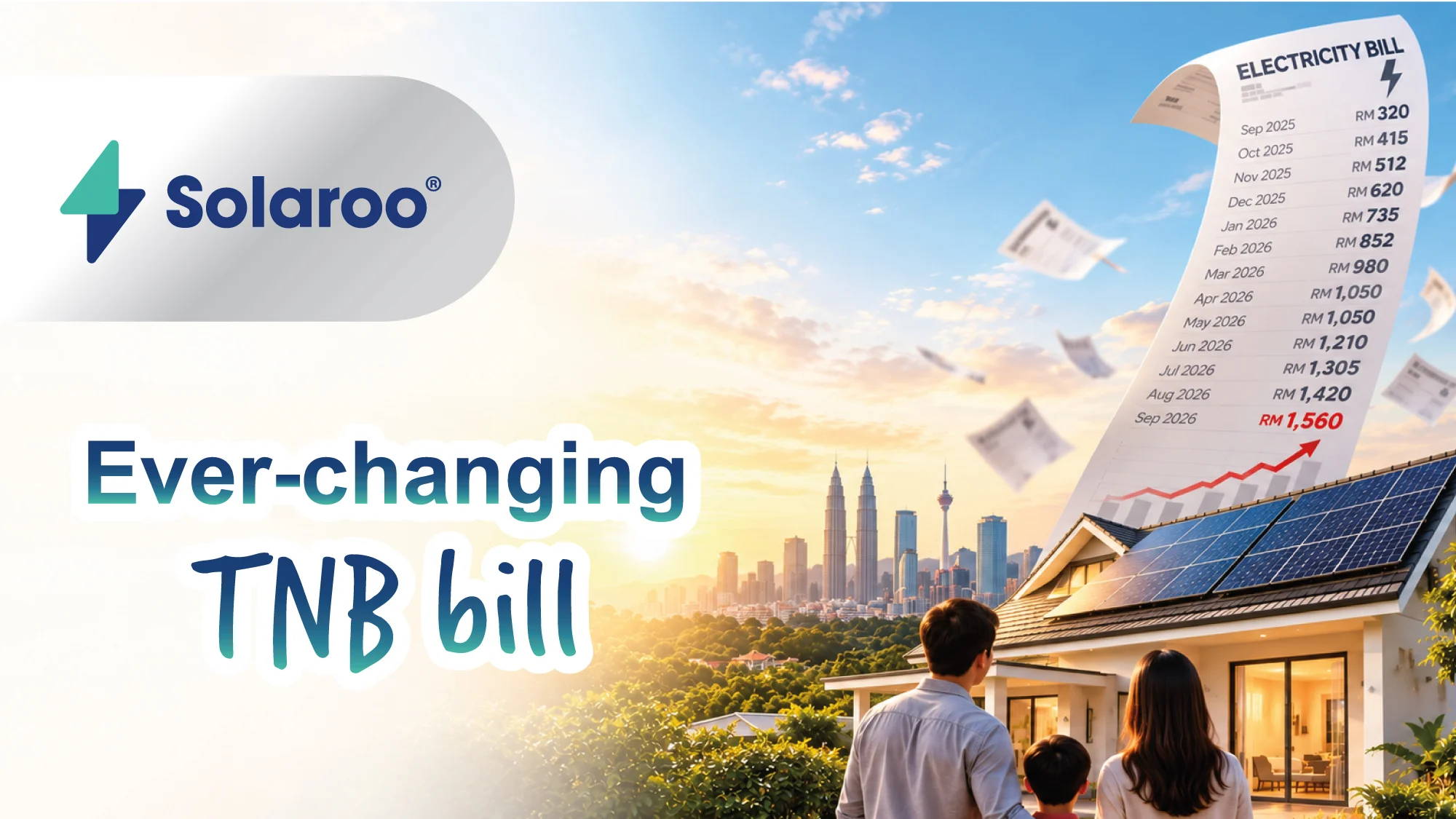
Your TNB bill keeps changing — and what to do about it
Jan 2026 → Sep 2026: from a RM60 rebate to a RM44 surcharge on the same 1,200 kWh home — an eight-month swing of about RM104
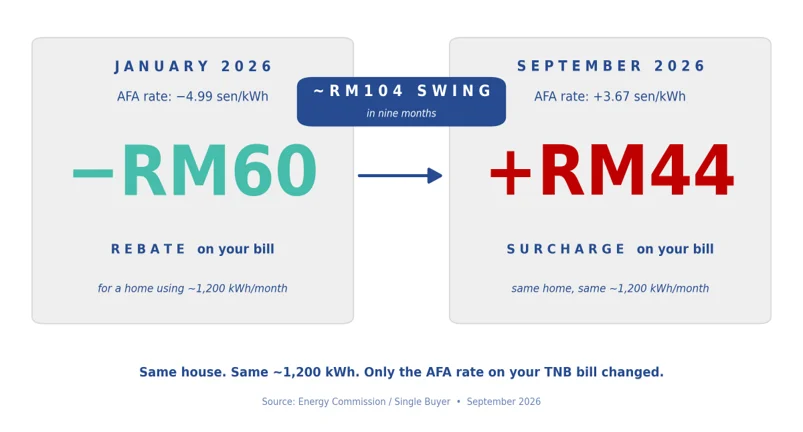
If you landed here from your August TNB bill — the extra you paid wasn’t your usage. It was the AFA (Automatic Fuel Adjustment) line on the bill. For a typical 1,200 kWh home, August cost about RM105 more than January — same house, same electricity.
Below: what August looked like, what September just did, and the one thing that actually shields you from any of it.
Your August bill: +3.80 sen/kWh — the fourth monthly rise in a row
August 2026’s AFA landed at +3.80 sen/kWh — the fourth consecutive monthly increase, and the highest AFA rate since the mechanism was introduced in July 2025.
To put that in context of where the year started:
- January 2026 was a rebate of −4.99 sen/kWh. A 1,200 kWh home had about −RM60 knocked off its bill.
- August 2026 was a surcharge of +3.80 sen/kWh. The same home paid about +RM46 extra.
- That’s a swing of roughly RM105 per month on the same electricity, in seven months.
The AFA is a monthly adjustment set by the Energy Commission (ST), tracking the actual cost of fuel used to generate electricity — coal, gas, and the ringgit’s exchange rate against the US dollar. When fuel is cheaper than the base assumption, you get a rebate. When it’s more expensive, you pay a surcharge.
Every kWh you use in the month is adjusted by the AFA rate — so a 1 sen/kWh AFA change is roughly RM1 for every 100 kWh you consume.
Source: Energy Commission (ST) and Single Buyer, monthly announcements.
And now September — a small ease, but the trend isn’t over
The September 2026 AFA rate published on 2 September at +3.67 sen/kWh — the first month-on-month drop since the surcharge era began. Not much of one (0.13 sen lower than August), but the direction is right.
Three things worth noting:
- It’s still a surcharge. Fifth consecutive month of positive AFA. September isn’t a rebate; it’s a slightly less painful surcharge.
- The government cushion looks thinner. In earlier months, the KWIE (electricity industry fund) had been absorbing part of the cost — RM206 million in July, RM51 million in August. September’s announcement doesn’t mention KWIE at all, which means the rate you’re being charged is the raw computed cost, not a subsidised version.
- Projections keep overshooting reality. When August was published, September was pencilled at +5.00 sen/kWh. The actual came in at +3.67 — 27% below forecast. Same pattern the month before: July’s outlook had projected August at +8.33; the actual was +3.80.
The honest read: costs are easing slightly month-to-month, but they’re not going away, and the cushion that softened earlier months is thinner or gone.
Source: Energy Commission (ST) and Single Buyer, published 2 September 2026.
The nine-month picture
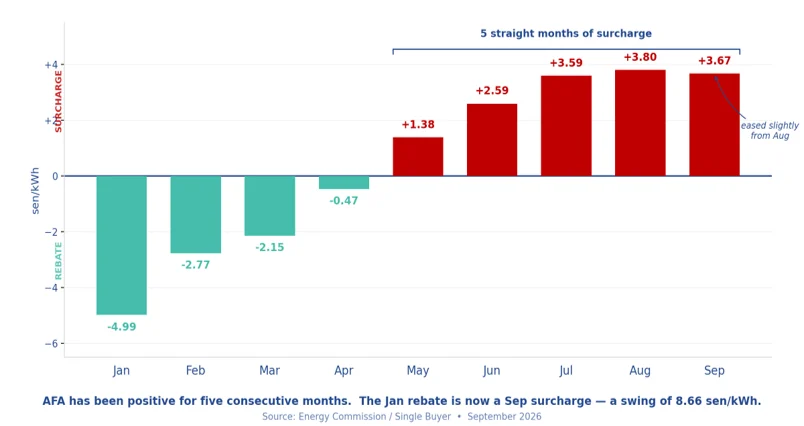
Bar chart of AFA rates from Jan through Sep 2026: rebates in teal (Jan −4.99, Feb −2.77, Mar −2.15, Apr −0.47) turning into surcharges in red (May +1.38, Jun +2.59, Jul +3.59, Aug +3.80, Sep +3.67), with a bracket highlighting five straight months of surcharge
|
Month |
AFA rate (sen/kWh) |
Meaning |
|
Jan 2026 |
−4.99 |
Deep rebate |
|
Feb 2026 |
−2.77 |
Rebate |
|
Mar 2026 |
−2.15 |
Rebate |
|
Apr 2026 |
−0.47 |
Rebate (nearly gone) |
|
May 2026 |
+1.38 |
First surcharge |
|
Jun 2026 |
+2.59 |
Surcharge |
|
Jul 2026 |
+3.59 |
Surcharge |
|
Aug 2026 |
+3.80 |
Surcharge (highest so far) |
|
Sep 2026 |
+3.67 |
Surcharge (5th month running) |
From January’s −4.99 to September’s +3.67, the AFA has swung 8.66 sen/kWh — a rebate has become a surcharge on the same electricity.
Find your number
The AFA is applied to every kWh you use in the month, so the impact scales with your usage. Here’s what it means at four common consumption levels:
|
Monthly usage |
Jan 2026 (rebate) |
Aug 2026 (surcharge) |
Sep 2026 (surcharge) |
Jan → Aug swing |
|
800 kWh |
−RM40 |
+RM30 |
+RM29 |
~RM70/month |
|
1,200 kWh |
−RM60 |
+RM46 |
+RM44 |
~RM105/month |
|
1,800 kWh |
−RM90 |
+RM68 |
+RM66 |
~RM158/month |
|
3,000 kWh |
−RM150 |
+RM114 |
+RM110 |
~RM264/month |
That’s the “why my bill looks different” number — the change from January, before any change in your actual usage.
Two rules that catch most people out
The 600 kWh rule. If your total monthly usage is 600 kWh or below, AFA is waived entirely — you pay nothing. Cross 600 kWh by even 1 unit, and AFA applies to all your kWh, not just the ones above 600. This is why a household that usually sits at 590 kWh can see a sharp jump in a hotter month when the aircon runs longer.
AFA applies to what you draw from the grid. For solar households on NEM 3.0 (net energy metering), the AFA is calculated on grid-drawn kWh, not on your gross usage. This matters — because the solar you use in real time (self-consumption) never touches the grid, and never touches AFA.
The one thing that actually shields you
There is exactly one part of your electricity bill that the AFA cannot reach: the kWh you generate and use in the same moment.
- Grid electricity → subject to tariff and Both are set by policy and fuel markets. Neither is under your control.
- Solar exported to the grid → credited at the AFA-affected rate. Useful, but still tied to the same swings.
- Solar you self-consume → not billed at all. Zero tariff. Zero AFA. Zero exposure to whatever the fuel market does next.
A typical Solaroo residential system covers 30–50% of a home’s monthly consumption through self-consumption alone (the exact share depends on daytime usage patterns and system sizing). That share of your bill is permanently insulated from AFA — whether next month’s rate is +3.67, +5.48, or back to a rebate.
What’s coming
TNB’s three-month outlook was revised down sharply when the September rate was published:
- October 2026: +3.36 sen/kWh — was +6.81 in the August outlook
- November 2026: +2.81 sen/kWh — was +7.50 in the August outlook
- December 2026: +5.48 sen/kWh — new, and higher again
The near-term picture is better than it looked a month ago — but the reprieve isn’t projected to last through year-end. And every projection this year has landed lower than forecast, so these numbers, too, may well come in below what’s pencilled.
What that leaves you with: the AFA is still a surcharge, and looks set to remain one into 2027. The 2025 rebate era is over. Fuel costs are the new baseline, and they move with global commodity prices, currency, and geopolitics — not with your usage.
What to do
If you have solar already: Check your bill for the AFA line. Compare it to what you were paying (or being rebated) in January. That gap — for most Solaroo homes, RM70–RM250+ a month depending on usage — is what your self-consumption is already saving you on top of the tariff itself.
If you don’t: Understand that your bill is exposed to two things outside your control (the base tariff and the AFA). Solar doesn’t change the tariff. But every kWh you self-consume is a kWh the AFA can’t touch.
In either case: Talk to us if you’d like your bill reviewed against what solar would offset. We’ll walk you through the numbers on your actual consumption, not on a generic assumption.
Figures verified as at 10 September 2026. AFA rates are set monthly by the Energy Commission of Malaysia; we update this page each month as the new rate is published. Any specific numbers in this article should be treated as accurate at the date of publication.
Read our previous AFA blog articles here: June AFA and AFA Explained.