Battery storage: Worth it under TNB’s Solar ATAP?
15th April 2026
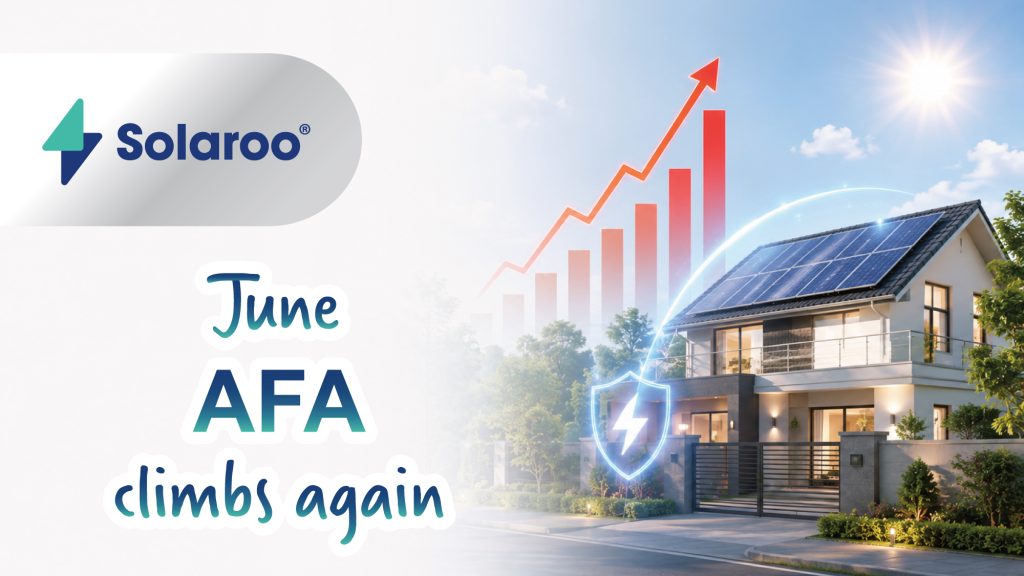
AFA increased again in June 2026. Here’s what it means for your electricity bill.
25th June 2026
“Why is my TNB bill higher this month?”
“I thought solar was supposed to protect me from this?
“What is this AFA thing on my bill?”
These are the questions landing in our inbox this week. This blog will unpack what AFA actually is, who it affects, and the most important — and most misunderstood — bit: what solar energy can and cannot do about it.
Why is my TNB bill higher this month?
The short answer: the Automatic Fuel Adjustment (AFA) flipped from a rebate to a surcharge in May — and it’s been shrinking for months.
| Month | AFA |
|---|---|
| Feb 2026 | −2.77 sen/kWh |
| Mar 2026 | −2.15 sen/kWh |
| Apr 2026 | −0.47 sen/kWh |
May 2026 |
+1.38 sen/kWh |
For a typical landed home using ~1,200 kWh/month, that’s roughly RM50 more compared to February. TNB has signalled the surcharge is likely to persist.
Who does AFA affect?
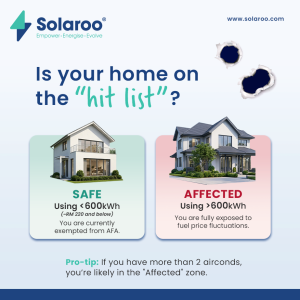
Only households using more than 600 kWh/month. Smaller households are exempt entirely.
“But I have solar — I’m protected, right?”
Not quite. This is the most common misconception.
- Solar you use directly (self-consumption) = no grid import = no AFA. ✅
- Solar you export back to the grid = credits that offset your energy charge, but not the AFA. ❌
The only real protection is using your solar in real time.
What can you actually do?
- Shift loads to daytime — pool pumps, EV charging, laundry. Run them when your panels are generating.
- Size for self-consumption, not maximum export.
- Already have solar? Check your dashboard. If you’re exporting more than 50% of your generation, there’s likely easy load-shifting on the table.
The bottom line
AFA is real, it’s rising, and it applies to every grid-imported kWh over the 600 kWh threshold. Solar helps — but only the kWh you actually use yourself.
AFA isn’t going away any time soon. Talk to us about going solar and we’ll show you exactly how much you could save.